
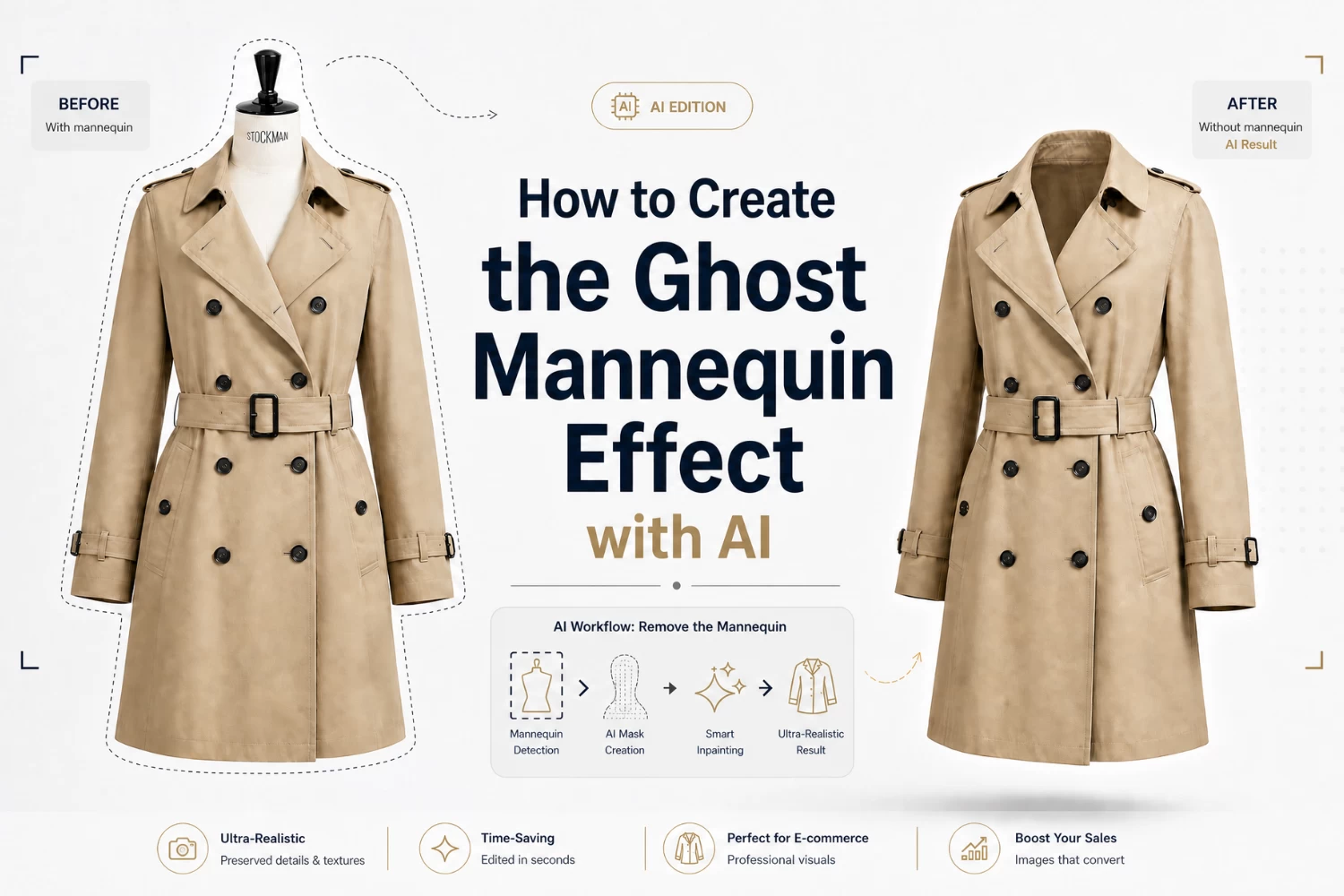
What Is Ghost Mannequin Photography?
Ghost mannequin photography, also called invisible mannequin photography, is a style of apparel photography in which a garment appears to be worn, but the mannequin is removed from the final image.
Instead of lying flat, a shirt can show its collar and shoulder structure. A blazer can hold its tailored shape. A dress can display its silhouette more naturally than it would on a table.
The technique is commonly used for:
– Shirts, jackets, dresses, knitwear, and uniforms
– Online clothing stores and marketplace listings
– Wholesale catalogs and seasonal collections
– Product pages that need a consistent, distraction-free look
A well-made ghost mannequin photo helps shoppers focus on the product itself: its cut, construction, texture, and overall form.
Why Ghost Mannequin Images Matter In E-commerce
Fashion product photography often has to balance two jobs.
First, it needs to be accurate. A shopper wants to see the neckline, sleeve length, seams, fastening details, and fabric appearance clearly.
Second, it needs to be appealing. Images should make a collection feel polished and trustworthy.
Ghost mannequin images are particularly good at the first job. They remove visual distractions while keeping the garment three-dimensional. This makes them a strong choice for main product images, especially when a store carries many colors, sizes, or related styles.
How Traditional Ghost Mannequin Photography Works
A traditional invisible mannequin shoot usually requires both preparation and editing skill.
The garment is first placed on a mannequin and adjusted carefully. Wrinkles are removed, seams are aligned, and clips may be used out of view to improve the silhouette. Lighting must be consistent, since harsh shadows or uneven exposure make later editing more difficult.
The photographer then captures the main product view. For garments such as collared shirts, hoodies, or jackets, a second image may be needed to show areas hidden by the mannequin, such as the inside of a collar or back neckline.
During post-production, the visible parts of the mannequin are removed. The hidden garment sections are added back in, edges are cleaned, and the final image is adjusted for color, shadows, framing, and background consistency.
Done well, this creates a convincing product image. But for a small fashion business or a seller launching many items at once, the process can take considerable time.
Where AI Fits Into The Workflow
AI does not remove the need for judgment. A poorly photographed garment with hidden details, incorrect color, or heavy wrinkles can still produce an unreliable result. What AI can do is reduce repetitive editing work and make it easier to develop more visual assets from the same product photo.
With PicWish, a fashion seller can start from a clothing image and work toward different ecommerce uses:
– A clean garment presentation suitable for a product listing
– A white-background image for marketplaces or catalogs
– An on-model variation using virtual try-on
– A lifestyle version with a new background
– A refined product image with improved presentation and consistency
This is where PicWish can take a distinct position: a ghost mannequin image is not necessarily the final destination. It can be the clean product foundation for a fuller gallery.
Is AI Ghost Mannequin Photography Right For Every Brand?
AI-assisted image creation can be especially helpful for smaller sellers, marketplace merchants, fast-moving catalogs, and brands testing new product presentations. It may reduce time spent on routine production and make it easier to prepare multiple image styles.
For premium collections, intricate garments, or products where texture and construction are central to the purchase decision, brands may still choose controlled studio photography and detailed professional editing for their core product images.
The most practical approach is not all-or-nothing. Use the method that matches the image’s purpose:
– Use clean ghost mannequin product images when shoppers need clarity.
– Use on-model images when shoppers need styling context.
– Use lifestyle visuals when a campaign needs atmosphere.
– Use careful review every time accuracy affects a purchasing decision.
How to Create Ghost Mannequin Photography with PicWish Ghost Mannequin Tool
With the PicWish Ghost Mannequin tool, you can turn a clothing photo into a clean, professional ghost mannequin product image without setting up a mannequin shoot or going through complex editing steps.
1. Upload your clothing photo
Go to PicWish Ghost Mannequin page and click Upload Image. You can also drag and drop, paste an image, or add an image URL. For the best result, use a clear photo where the garment is fully visible and details such as the collar, sleeves, buttons, patterns, or logos can be seen clearly.
2. Choose the view angle
Select the view you want for your ghost mannequin image:
- Front for a front-facing product view
- 45° View for an angled product view
- Back for a rear view
 Choose the angle that best suits your product listing or ecommerce gallery.
3. Select the resolution and aspect ratio
Choose your preferred output resolution from 1K, 2K, or 2K+. You can also select an aspect ratio or leave it set to Auto.
 For standard ecommerce product images, Auto can be a convenient option if you don’t need a specific format.
4. Generate your ghost mannequin image
Once your image and settings are ready, click Generate. PicWish processes the clothing photo and creates a polished ghost mannequin product image while maintaining the garment’s key visual details.
5. Check the product details before saving
Review the generated image carefully, especially around the collar, cuffs, hems, fastenings, logos, prints, fabric texture, and color. Make sure the result accurately represents the actual garment before using it in your online store, catalog, or marketplace listing.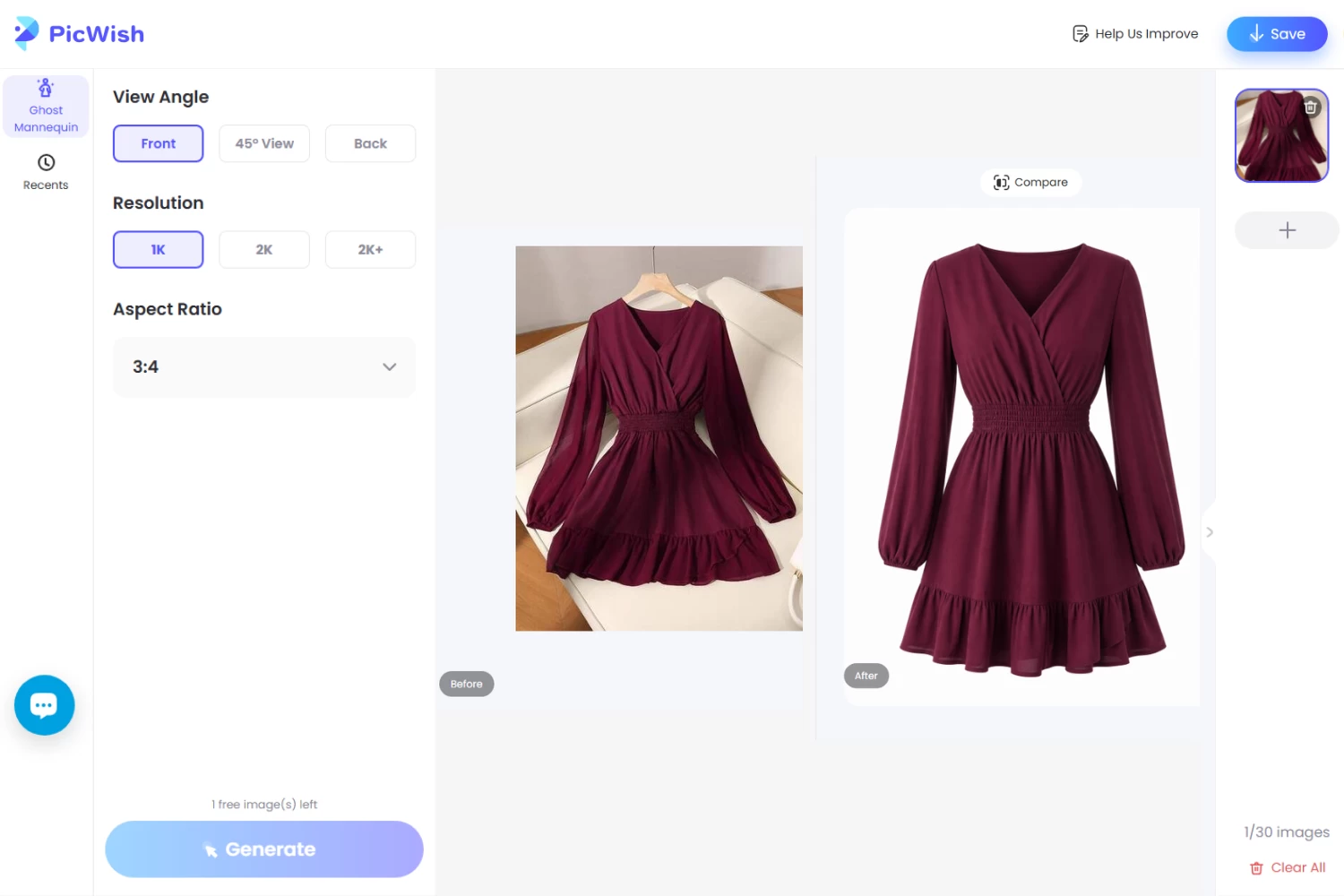
Once approved, click Save and your ghost mannequin image can serve as a clean primary product visual or as part of a wider fashion ecommerce gallery.
Frequently Asked Questions
📍Is ghost mannequin photography the same as invisible mannequin photography?
Yes. The terms are commonly used interchangeably to describe clothing images that retain a worn, three-dimensional look without showing the mannequin.
📍Is ghost mannequin photography good for e-commerce?
It is particularly useful for e-commerce because it presents clothing clearly and consistently. It can help shoppers inspect the structure of shirts, dresses, jackets, and similar products without distractions.
📍 What is the difference between ghost mannequin and flat lay photography?
A flat lay shows a garment positioned on a flat surface, while a ghost mannequin image shows it with more natural shape and volume. Flat lays can work well for simple items or styled content; ghost mannequin photos are often stronger for structured apparel.
📍Should I use ghost mannequin photos or model photos?
Both can be valuable. Ghost mannequin photos are useful for showing product detail clearly, while model photos help shoppers understand styling and visual fit. Many product galleries benefit from including both.
📍Can AI create ghost mannequin product images?
AI tools can help create or refine ghost mannequin-style product visuals from clothing photos, reducing some of the manual work associated with traditional editing. Outputs should still be checked carefully for color, construction details, patterns, and edge accuracy.
Conclusion
Ghost mannequin photography has stayed relevant for a simple reason: it helps shoppers see clothing clearly. It gives garments shape without adding distraction, making it valuable for product pages, catalogs, and marketplace listings.




Leave a Comment